
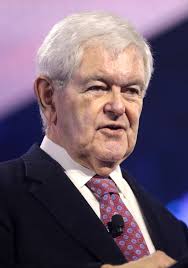
Newt Gingrich
Newt Gingrich
As a politician, Newt Gingrich would say, “I grew up in kind of an idyllic children’s background.” But really, he grew up above a gas station in a life that was “narrow and harsh and unforgiving” (Packer 18). He got his first taste of leadership at ten, when he tried to convince the Parks Department to build a zoo for Harrisburg, making the front page. His ambition became more serious when he visited the scarred battlefields of Verdun and saw what bad leaders could do to a country. With Lincoln and Churchill as his models, he decided that “his future was in politics” (19).
Newt Gingrich married Jackie Battley when he was nineteen. While she worked, he went to Tulane for his Ph.D. and became a campus activist. When Tulane banned two films, Gingrich organized protests against the decision. “He had a favorite phrase, ‘corrupt elite,’ that could be hurled in any direction, and for the rest of his life, he kept it in his pocket” (20).
While teaching college history, Gingrich ran for Congress in 1974 and 1976, losing both times. In 1978, he ran again. “He didn’t make racial appeals, didn’t seem very religious.” He understood the New South, where his love for aircraft carriers, moon launches, and personal computers was a perfect fit for the emerging Republican majority. With stagflation and a president preaching sacrifice, people were sour, suspicious of bureaucracies, and antitax. Gingrich’s opponent was a wealthy, liberal, female state senator. He knew exactly what to do. He moved to the right and went after her on welfare and taxes with his new pocket phrase, “the corrupt liberal welfare state.” Meanwhile, he talked about family values and featured Jackie and their kids in his ads. Though he was cheating on Jackie and they would soon divorce, Gingrich was elected to Congress in 1978 (21).
In Congress, Gingrich developed another phrase to keep in his pocket, “corrupt, left-wing machine.” He baited Speakers of the House until they were red in the face. He understood that politics was war, and he was the general. By 1994, he led the 'Contract with America' and became Speaker of the House, changing American politics forever.
Work Cited
The Unwinding: An Inner History of the New America, by George Packer. Published by Farrar, Straus and Giroux, 2014.
© 2024 7th Grade Digital Literacy Class | Images from Wikimedia Commons
Support Our Historical Research
Help us continue providing high-quality resources for understanding complex historical narratives.
Contact Us